
Scan with a phone camera to open the article. Suitable for posters and notices.
The University of Shatrah took part in the scientific exhibition specialising in oil research projects held by the Dhi Qar Oil Company under the patronage of the Deputy Prime Minister for Energy Affairs and Minister of Oil, Hayyan Abdul-Ghani Al-Sawad, and under the supervision of the company's Director General, expert engineer Saeed Zghair Shlaka, with the participation of five Iraqi universities. The exhibition was held on Thursday 14 May 2026.
The university's delegation was headed by the Assistant President for Scientific Affairs, Prof. Dr. Fadhil Mohsen Hamad. This year's participation was distinctive and effective, comprising more than 15 scientific research papers and patents presenting advanced technical solutions in the fields of improving oil production, addressing environmental challenges, and developing drilling and exploration technologies.
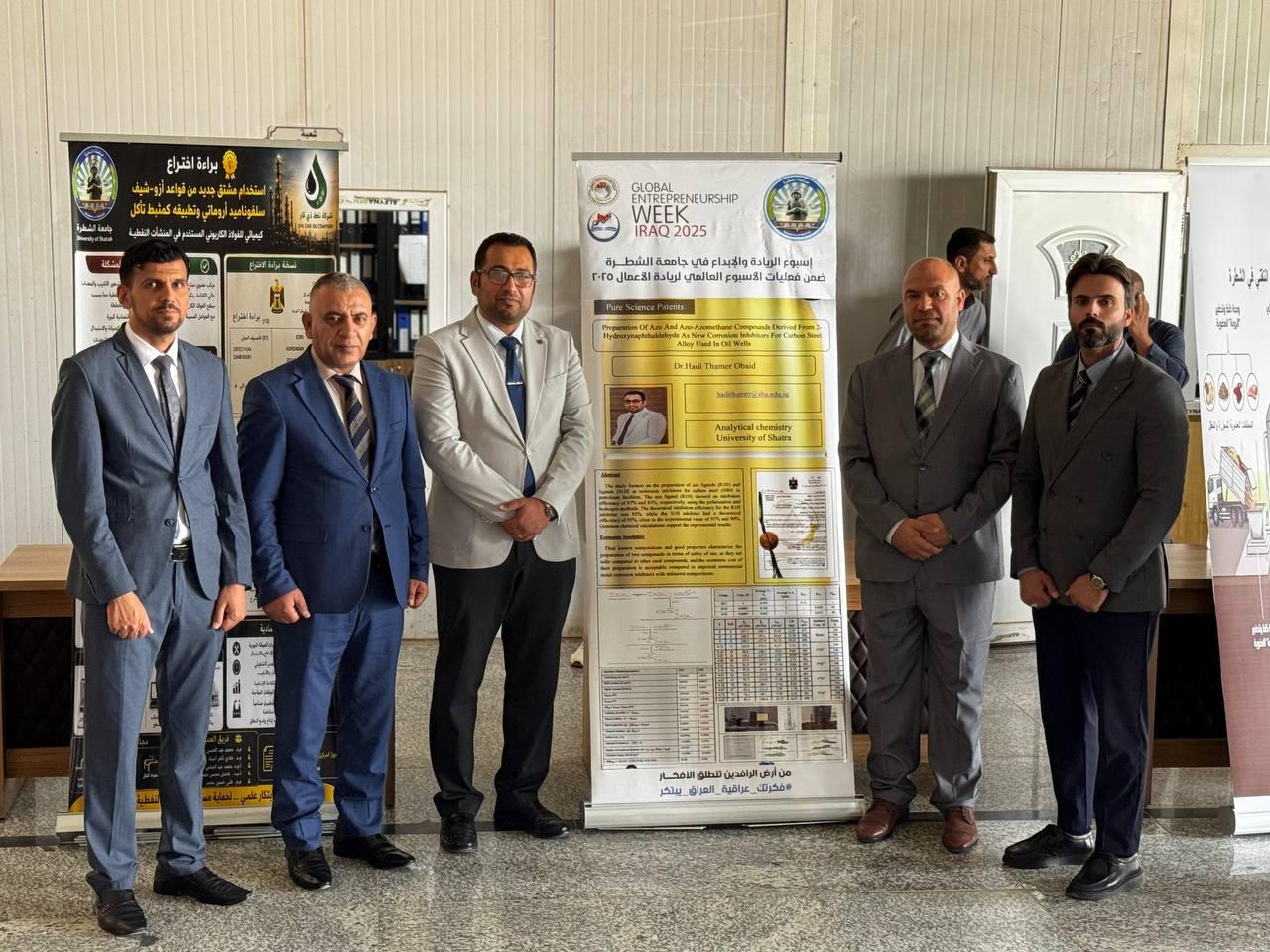
The university's participation included the presentation of a patented research study by a group of the university's teaching staff, comprising Prof. Dr. Fadhil Mohsen Hamad, Asst. Prof. Dr. Mohammed Abdul-Abbas and Asst. Prof. Dr. Hadi Thamer, which dealt with "the preparation of inhibitors with known compositions and high safety properties, which are safer than commercially available inhibitors. Their efficiency has been proven experimentally and theoretically, and they are cheaper to prepare than imported inhibitors of unknown composition".
The delegation also took part with an applied research study based on a methodology of using expired medicines as metal corrosion inhibitors in oil pipelines, an approach that offers low-cost and environmentally friendly solutions by recycling these materials and converting them into effective anti-corrosion compounds.
In a speech during the exhibition, the Assistant President for Scientific Affairs affirmed: “The University of Shatrah is moving steadily towards strengthening its research role as a sound scientific institution, by supporting applied research and developing innovations that serve the oil and energy sector. Our participation today is a practical embodiment of the partnership between universities and the productive sectors of the state, achieving sustainable development and enhancing the standing of scientific research in the service of society.”